
What we treat
Protecting the optic nerve
- Open-angle glaucoma
- Angle-closure glaucoma
- Laser iridotomy
- Laser trabeculoplasty
- Trabeculectomy
- Drainage devices
What is glaucoma?
Glaucoma is a condition in which the pressure inside the eye is high enough to damage the optic nerve. It is one of the leading causes of blindness, common in adults over forty — and that blindness can be prevented if it is diagnosed early.
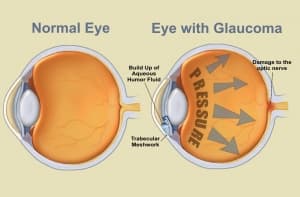
In a normal eye, a clear fluid called aqueous humour is made and continuously drained through microscopic channels into the blood vessels. If these channels are blocked, the fluid builds up and the pressure rises. Left uncontrolled, it damages the optic nerve and leads to blindness.
Glaucoma is broadly of two kinds: open-angle and closed-angle (angle-closure).
Types and symptoms
Open-angle (chronic) glaucoma
The most common type. Vision is lost gradually and painlessly, and it is usually found at a routine eye check-up.
- Gradual dimming of vision — blurred or foggy
- Frequent change of glasses without real improvement
- Mild, persistent headache; blind patches at the edge of vision
- Coloured halos around lights
Acute / closed-angle glaucoma
Some people are born with a narrow drainage angle, which can suddenly block and send the pressure up.
- Severe eye pain with headache and facial pain
- Sudden blurring of vision
- Cloudy vision with halos around lights
- A red eye, with nausea and vomiting
Sudden eye pain with blurred vision, halos and vomiting is an emergency — come to the hospital straight away.
Treatment
The aim is to bring the eye pressure down to a level that will not damage the optic nerve. This stops further loss of vision, but damage already done cannot be reversed.
Eye drops
Used regularly, as prescribed, to lower and control the pressure.
Tablets
For a short time, to bring the pressure down during an acute attack, or when drops alone are not enough.
Laser iridotomy
For acute or narrow-angle glaucoma: the laser makes a small opening in the iris to relieve the blockage of the drainage channels.
Laser trabeculoplasty
For open-angle glaucoma: the laser opens the blocked passages so the fluid can drain out of the eye.
Trabeculectomy
Surgery that creates a new channel for the fluid to drain, bypassing the blocked ones. Useful in most types of glaucoma.
Glaucoma drainage devices
These are usually reserved for severe, uncontrolled glaucoma where earlier surgery has failed. They can also be the first operation where a trabeculectomy is likely to fail — as in neovascular and uveitic glaucoma — and are commonly used for congenital and developmental glaucoma.
Other uses include glaucoma after injury, after cataract surgery or corneal transplant, and other secondary glaucomas. Increasingly they are also considered as a first operation for uncontrolled primary open-angle glaucoma. Your eye surgeon is the best guide on whether a device is right for you.
The best defence
The best defence against glaucoma is a regular eye check-up, especially after forty — and for everyone with glaucoma in the family.