
What we treat
Stitchless surgery, clearer vision
- Phacoemulsification
- Micro-incision surgery
- Multifocal & trifocal IOLs
- Toric IOL for astigmatism
- Optical biometry
Cataract surgery in Patna, Bihar
The clouding of the eye’s normally clear lens is called a cataract. The word comes from the Latin for ‘waterfall’. A cataract develops gradually — how fast varies from person to person, but it usually takes months or years before it affects vision.
Cataract surgery is the most commonly performed operation, and it is safe and effective, improving vision in 95% of patients.
Causes of cataract
Age-related cataract
With age, the fibres of the lens slowly become opaque.
Traumatic cataract
- A penetrating injury
- Concussion, electric shock or lightning
- Radiation given for tumours
- Surgical trauma
Metabolic cataract
- Diabetes
- Galactosaemia (an inborn error of metabolism)
- Calcium disorders
Steroid-induced cataract
From long use of steroid tablets or steroid eye drops.
Secondary cataract
Following another eye disease, such as chronic inflammation or glaucoma.
From couching to phaco
Maharshi Sushruta pioneered the surgical treatment of cataract in India with ‘couching’ — pushing the clouded lens backwards out of the line of sight. The technique lasted more than two thousand years, into the eighteenth century.
Microsurgical instruments and phacoemulsification have since made couching obsolete.
Evaluation before surgery
Visual acuity
Unaided, corrected and pin-hole vision — to judge how the macula is working and what surgery can achieve.
Intra-ocular pressure
To find any raised pressure that needs treating as well.
Slit-lamp examination
Shows the type, density and cause of the cataract, and any other eye disease.
Direct and indirect ophthalmoscopy
A full check of the retina. A dense cataract may need a B-scan ultrasound instead.
A-scan biometry
Measures the eye’s length to calculate the power of the lens implant, for mature cataracts.
Optical biometry
A precise, non-contact measurement that is more comfortable for the patient.
Treatment
Phacoemulsification — micro-incision cataract surgery
Phacoemulsification is the latest technology in cataract surgery. Through a micro-incision, without stitches, the cataract is emulsified by ultrasound energy, liquefied and removed through the phaco probe.
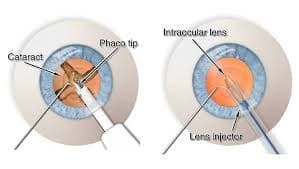
Advantages
- Stitchless, with rapid healing
- Done under drops only (topical anaesthesia); usually no eye patch
- Corrects vision for distance and near
- A quick return to normal activities
Extra-capsular cataract extraction (ECCE)
- A 10–12 mm incision
- The clouded lens is removed in one piece
- Several stitches are needed
- A non-foldable lens is implanted
Lens implants (IOL)
When the natural lens is removed, an artificial intraocular lens (IOL) is placed in the eye to restore its focus — much like fitting a lens back on a camera.
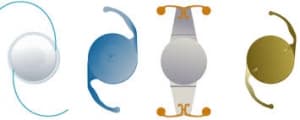
Monofocal IOL
Clear focus at one distance only.
Multifocal IOL
Vision for both distance and near.
Trifocal IOL
Near, intermediate and far — especially useful for people who work on a computer.
Apodised diffractive multifocal IOL
Graduated diffractive steps bend light to several focal points, for smoother vision across lighting conditions.
Accommodative IOL
Moves with the eye’s focusing muscle to improve sight at several distances. Crystalens and Trulign Toric are the US-FDA-approved lenses of this kind.
Toric IOL
A monofocal lens with built-in correction for astigmatism.
Protective filters
Lenses with UV and blue-light filters, chosen to suit each patient.
Astigmatism
Astigmatism blurs both near and distant vision because the cornea is curved like a rugby ball rather than round. A toric IOL corrects significant astigmatism; limbal relaxing incisions, at the same time or separately, can make the cornea more symmetrical.
After surgery
Once the eye has healed, vision can be fine-tuned further if needed — with an IOL exchange, an additional (piggyback) IOL, limbal relaxing incisions, or laser refractive treatment.
If you have had LASIK or other refractive surgery, tell your surgeon — it affects how the lens power is calculated.